
26 Nov Spain: an intersectional fanzine from València, by Fractals
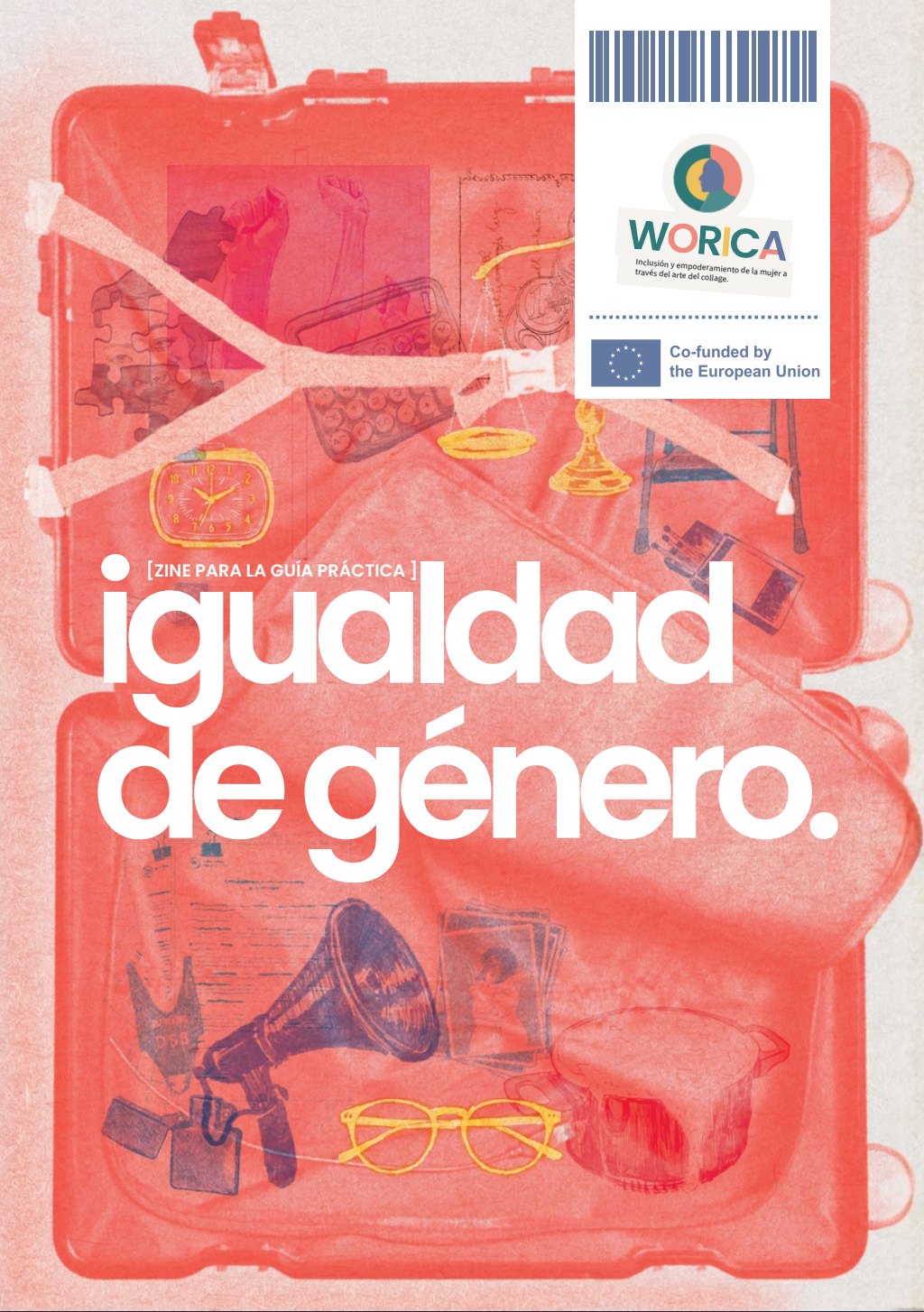
The Spanish edition of the WORICA fanzine comes from València, from Fractals Educación Artística – the partner that also designed the zine for the whole project. Available in Spanish and in English, it looks at women’s rights through an intersectional lens and ends with the widest map of support in the series: more than twenty services over eight pages.
When discrimination does not come alone
Spain has a broad legal framework on real and effective equality, equal treatment, work–life balance and protection from gender-based violence, and its laws pay explicit attention to situations where gender discrimination overlaps with migration, disability and other vulnerabilities. The fanzine turns this idea into a few lines that anyone can recognise:
Being a migrant, living with a disability, or facing economic hardship doesn’t just add to the difficulty. It multiplies it.
WORICA fanzine, Spanish edition (English version)
It gives an example that many participants knew from their own lives: a migrant woman may face “a double exclusion: as a woman, and because her qualifications aren’t recognized, pushing her into caregiving or cleaning work regardless of her education”. And it draws the conclusion without softening it: “This isn’t accidental. It’s how structural discrimination keeps women on the margins.”
The same lens runs through the rights section. One of the seven rights is protection regardless of migration or legal status: all women, “including migrant women without regular administrative status”, have the right to report violence, to reach emergency shelters and to receive medical and legal support without fear.
A directory that follows real needs
Where other editions concentrate on helplines, the Spanish directory follows the many sides of a woman’s situation – safety, papers, work, income, disability – and says in one line what each service does:
- In an emergency – 112, and 016, the free and confidential 24-hour helpline against gender-based violence, with legal advice from the very first contact; it can also be reached on WhatsApp (+34 600 000 016). In València, the 24-hour Women’s Centre: 900 580 888.
- Public institutions – the Government Delegation against Gender-Based Violence; the Women’s Institute (914 528 500) and its social and labour integration programmes; the line 021 for victims of racial or ethnic discrimination and 028 against LGBTI-phobia; and ONDIS, the Office for Non-Discrimination of València City Council.
- For migrant and refugee women – Red Acoge / Valencia Acoge for legal advice and integration; Accem, with support groups for women; CEPAIM and the Red Cross for social and labour integration; and the Aminata Network, which works to prevent female genital mutilation and supports survivors.
- After violence – Por ti mujer, with psychological, social, legal and employment support and shelter; ANAR for children and young people exposed to violence; and the WRAP map, which geolocates support services, shelters and counselling across Spain.
- For women with disabilities – XARXA, the network of women with disabilities in València, and the CERMI Mujeres Foundation.
- At work – the trade unions CCOO, UGT, CGT, CNT and Intersindical, for advice on breaches of employment law or situations of abuse.
- Income and inclusion – the Valencian Inclusion Benefit and the programmes funded by the 0.7% of personal income tax.
The message of the directory is that asking for help is not only about emergencies. A union, an income benefit or a network of women with disabilities can be part of the way out, too. As the fanzine says: “Knowing these resources exist, and having them close at hand, is itself a form of protection.”
A collective glossary, an ABC of collage
In València, Fractals explored with the participants how gender intersects with race, migration status, age, sexual orientation, class and care responsibilities. Over three sessions, with 10, 12 and 8 women, they built a collective glossary and a “Collage-ABCdario”, and used body mapping and role-play to connect what they knew, what they felt and what they could do. They kept returning to one question: what happens when rights exist, but institutions and procedures do not respond to real circumstances?
The result was a set of meanings built from lived experience rather than an “official school” definition – and that is the spirit of the Spanish fanzine. Read more about Fractals Educación Artística.
Download, share, use it
All WORICA fanzines are free to download, print and share – together with the WORICA Handbook and the national Glossaries – in the Downloads section of worica.eu. If you work with women in a training centre, a community group or a counselling service, you are welcome to use them in your own sessions.
Read about the fanzine and its other editions, discover the stories behind them on the Women Empowerment Shows page, and follow @worica_eu on Instagram for the session films.
WORICA – Women inclusion and empowerment through collage art – is a 30-month Erasmus+ Cooperation Partnership in Adult Education (2025-1-SE01-KA220-ADU-000350853), coordinated by Folkuniversitetet (Sweden) with CEIPES (Italy), Brûlant·e·s (France), Fractals Educación Artística (Spain), ÖJAB (Austria) and SOFFA – Social Fashion Factory (Greece). It supports women aged 30–64, with a strong focus on women with migrant backgrounds, through rights education and collage art. Funded by the European Union.
Sorry, the comment form is closed at this time.